Compliance
How a Compliance Program Works
A product that passed a compliance workshop passed a defined set of tests on a defined day. That is a useful fact, and it is a narrower one than most marketing copy suggests.
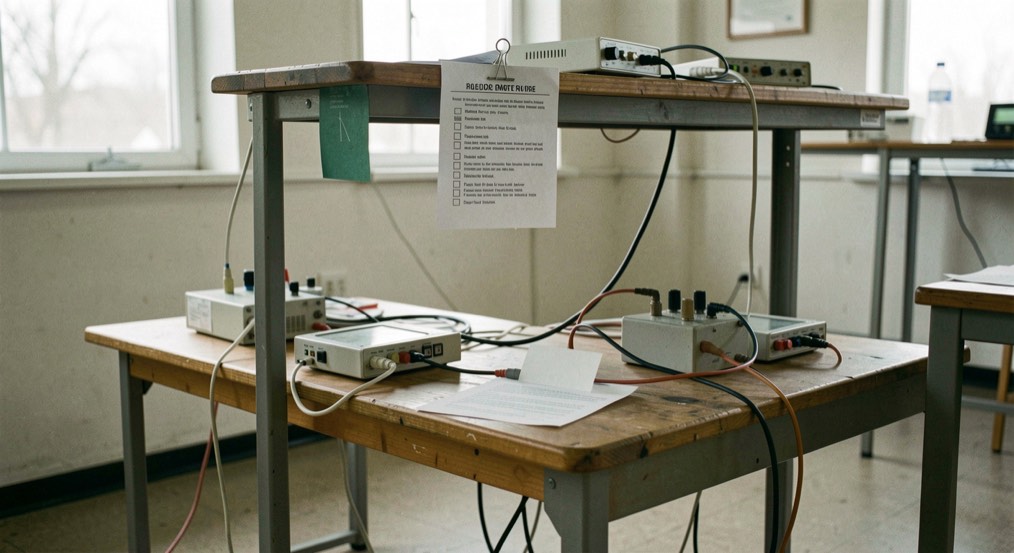
A compliance figure is a dated measurement
A compliance claim on a datasheet is a historical statement. It says that one product, on one day, met a defined set of tests drawn from one revision of the specification. Everything else the word seems to promise is supplied by the reader. The habit worth building is to treat the figure the way you would treat a scope capture: an instrument, a configuration and a date sit behind it. This page works through where the program came from, what a pass is measured against, and which of the documents underneath it you can still open today. The bound that a measurement day is trying to establish is priced in what a bit error rate counts, and what a single day can and cannot prove is taken apart in test and retest.
What does the testing actually consist of?
The commonly described shape of the program is a workshop, informally a plugfest, where companies bring hardware and test interoperability and signal integrity against each other, with products that pass recorded on a public Integrators List. The desk cannot put a document behind that description. The pages that describe it could not be reached during the research for this site, and the sources that were read do not describe the workshops or the list either. Treat it as common industry usage rather than something the desk could trace to a document it read. What can be said is that a compliance program exists to turn a specification into a measurable pass.
Where did the program come from?
The documented part of the story is older than the bus this desk follows. The consortium responsible for the PCI, PCI-X and PCI Express specifications is the PCI Special Interest Group, formed in 1992, and it formed as a compliance program: its initial purpose was to help computer manufacturers implement the original PCI specification. The checking side came first. Its specifications are distributed to members as free downloads, so the document and the apparatus for verifying a product against it have been separate artifacts from the start. A specification tells a part what to do. A compliance program is the attempt to find out whether a given part does it, and no amount of compliant wording on a box merges the two.
The eye, and the template drawn over it
Most of the signal-integrity side of a pass comes down to one picture. An eye diagram is built by sampling a digital signal repeatedly against the unit interval, the bit period, and overlaying the traces, which turns thousands of edges into a map of the signal's voltage probability density over time. On a PCIe lane it is the standard way to see the combined effect of channel noise, dispersion and intersymbol interference. An open eye means minimal distortion. A closed eye means interference and noise have degraded the signal far enough to risk bit errors at the receiver. The pass or fail line is usually an eye mask, a forbidden voltage and time template the measured eye has to clear. That term is common test-and-measurement practice rather than something the desk could trace to a document it read. The mechanics of the picture are taken further on the page about reading a receiver eye.
Which documents can you still open?
One of them this desk read end to end: the PHY Interface for the PCI Express, SATA, USB 3.2, DisplayPort and USB4 Architectures Specification, revision 7.1, September 2025, Intel reference number 643108. It names the signalling rates a PHY may present and the state machine that brings a link up, and it is the source behind the page on the PIPE interface.
| Item | As printed in the document |
|---|---|
| Title | PHY Interface for the PCI Express, SATA, USB 3.2, DisplayPort and USB4 Architectures Specification |
| Revision and date | Revision 7.1, September 2025 |
| Publisher reference | Intel reference number 643108 |
| PCIe signalling rates named in the rate tables | 2.5, 5.0, 8, 16, 32, 64 and 128 GT/s |
| Encodings named in the layer table | 8b/10b, 128b/130b, 1b/1b for the SerDes variant, 128b/132b for USB at 10 GT/s |
| LTSSM states named in the normative text | Detect.Quiet, Polling, Configuration, Recovery, L0, L0s, L1, L2, Loopback, Disabled |
A compliance program turns specification text into repeatable checks: a test suite exercises a link or a device against the requirements of a given generation, results are logged, and failures are traced back to the clause they violate. Reading those results well depends on knowing how a requirement is worded, since a clause that says shall, should, or may carries a different weight in a test report. That distinction is the subject of a newer page on the verbs a clause uses, which sets out the normative language a reader will meet throughout the specifications cited here.
A compliance program tests a device against the specification rather than against a vendor's claims, so the first step is to fix the revision of the base specification and the applicable engineering change notices, then run the prescribed transmitter, receiver, and link training measurements at each supported rate. Results are recorded per test point, with the test setup and any deviations noted, because a pass at one rate or form factor does not carry over to another. The same reading method applies when a datasheet is checked line by line against the specification, which is the subject of a newer page on the supplier's own figures.
The scope line, verbatim
Revision 7.1 states: "This revision includes support for PCIe implementations conforming to the PCIe Base Specification, Revision 7.0, SATA implementations conforming to the SATA Specification, Revision 3.0, USB implementations conforming to the USB Specification, Revision 3.2, DisplayPort implementations conforming to the DisplayPort 2.0 Specification, and USB4* implementations conforming to the USB4* Specification v2.0."
The same research pass turned up a second address and a hole where its target should be. An Intel chipset datasheet of June 2004 tells the reader to refer to document 300312-001, at an address on this domain, for more information about the receiver compliance eye diagram. The document could not be retrieved in 2026 from Intel, from the consortium, or from the Internet Archive. The citation is real. The target could not be found, and this page does not reconstruct it. The record a live document keeps of its own corrections, change bars and errata sheets, is the subject of the document's memory.
What a pass does not cover
A pass on a given day says nothing about what a platform does when a link degrades afterwards, and the specification set documents that separately. The PCIe base specification, revision 7.0, defines Advanced Error Reporting in section 6.2 and Downstream Port Containment in section 6.2.11. Where the second is supported, a detected error disables the link to the entire sub-hierarchy below the faulting device, which leaves every device under it inaccessible until the link is reset and a subsequent slot-reset step completes. Where the first is supported, a faulting device may already be accessible at the first, Notification, step of a Linux kernel error-recovery sequence. That is behaviour under field conditions, a different question from the one a test day answers. The boundary where the test day's evidence is accepted as a delivery is drawn by the sign-off checklist.
Before you quote a compliance figure
- Find the specification revision the claim was measured against, and read its date.
- Ask which document the test procedures came from, and whether it is still obtainable.
- Check that the vendor names a measurement, such as a receiver eye, rather than the word compliant alone.
- Open a primary document where you can: revision 7.1 of the PIPE specification names its rates, encodings and LTSSM states in tables.
- Note what the claim is silent about, error reporting and link containment among them.
Common mistakes
- Reading a compliance figure as a property of the part instead of a record of one test day.
- Repeating the workshops or the Integrators List as sourced fact, when the pages describing them could not be reached.
- Crediting the PIPE specification with LTSSM state behaviour. Revision 7.1 names the states, it does not describe each one.
- Inventing a title or contents for document 300312-001, which could not be found and is not reconstructed here.
The concrete step is small. Take one compliance figure from a datasheet you are working with and trace it to a document: revision, date, section, and the name of the measurement. If the trail ends at a document you can open, the figure is usable. If it ends at the word compliant, that is a finding too, and the question to send back is which document the pass was run against.